Description
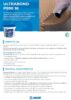
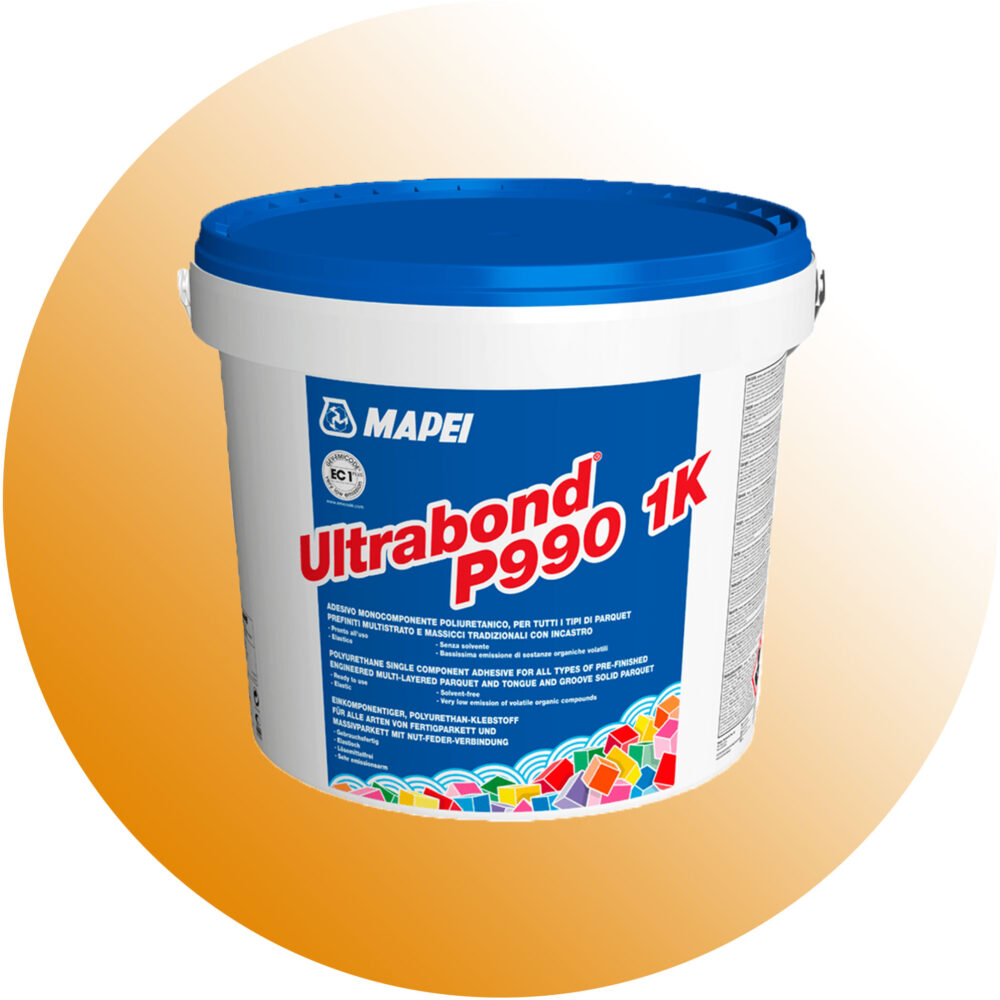
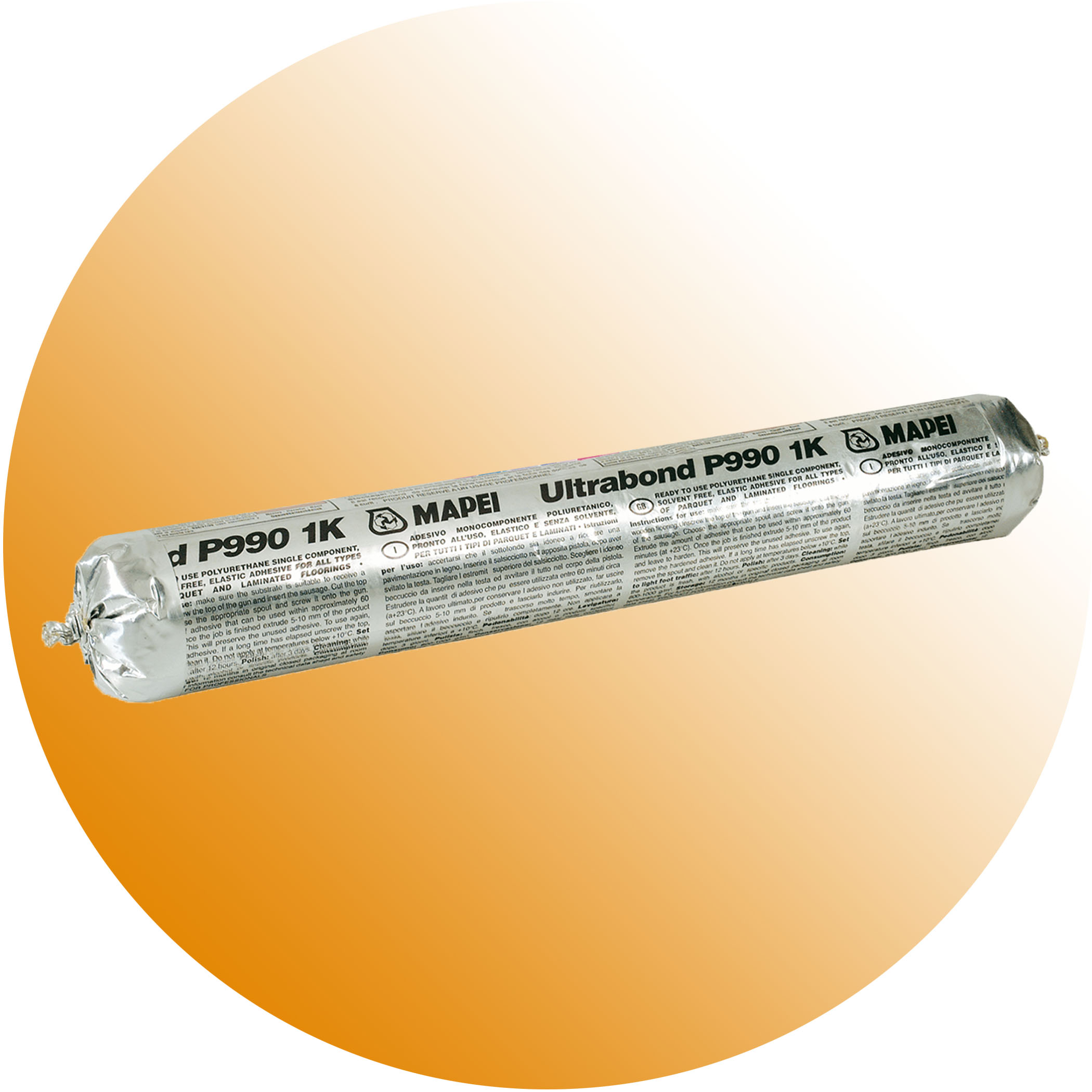
Mapei Ultrabond ECO P990 1K – Timber Flooring Adhesive
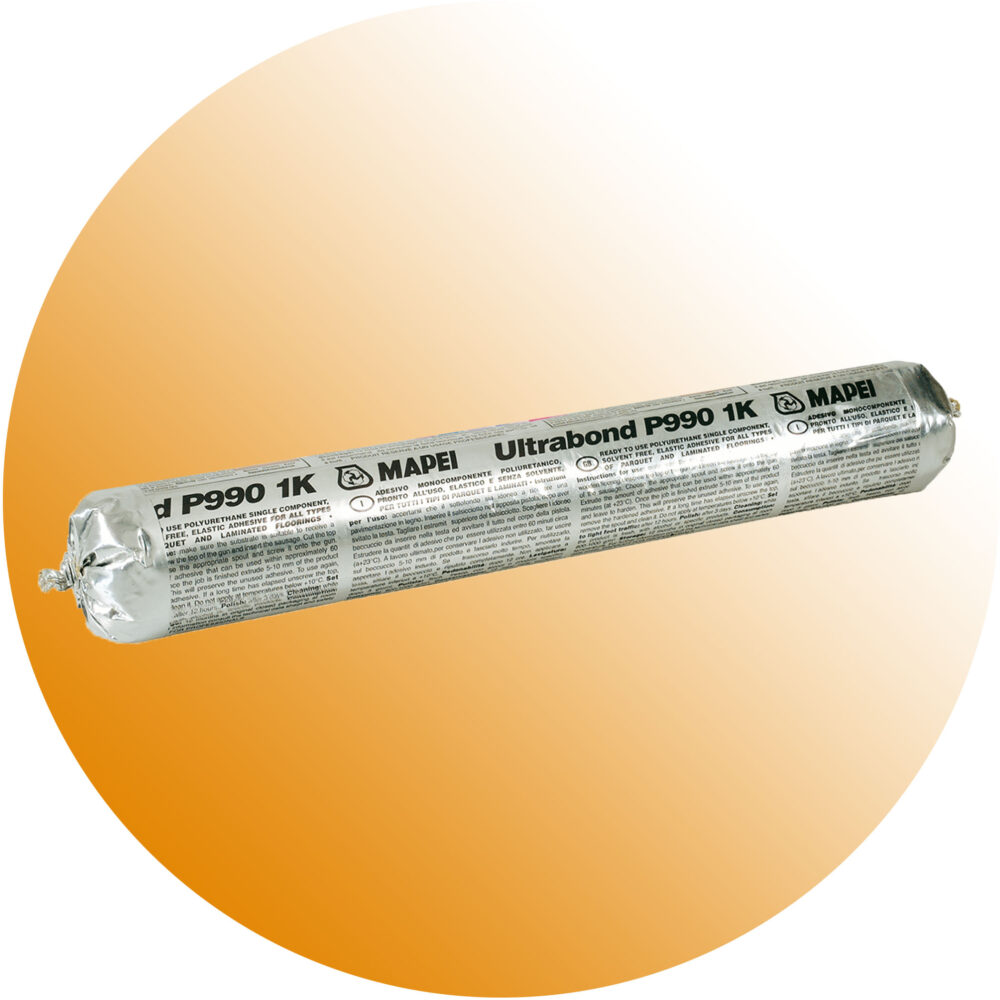
– 600ml Sausage
Mapei Ultrabond ECO P990 1K is a one-component, solvent-free, ready-to-use,
elastic polyurethane adhesive with very low volatile organic compound (VOC)
emissions, suitable for all types of multilayer pre-finished parquet and
traditional interlocking solid wood floors.
Suitable for:
- Bonding of interlocking solid wood parquet, prefinished with a
multilayer support of any format and wood species. - It is not recommended to install prefinished solid wood with varnish on
the underside or traditional solid wood parquet without interlocking.
Ultrabond P990 1K is used for bonding interlocking prefinished parquet,
slats, planks, and lamparquet onto:
- cementitious screeds
- screeds made with Mapecem, Mapecem Pronto, Topcem, Topcem Pronto and
similar - existing wooden floors
- ceramics, marble, terrazzo floors, etc.
- anhydrite screeds
- Suitable also for heating substrates.
Ultrabond P990 1K is a moisture-curing polyurethane resin-based adhesive; produced
according to technology developed in MAPEI laboratories. The product has the
following characteristics:
- Ready-to-use, one-component, does not require the addition of hardener
and subsequent mixing. Leftover quantities, when stored properly, can be reused for
subsequent applications. - It can also be used by installers who are allergic to epoxy-
polyurethane products. - Easy to apply, even at low temperatures.
- It has a yield that is over 30% higher than traditional two-component
products, thanks to the low viscosity and the smooth application of the adhesive
under the trowel, even at low temperatures. - The excellent ridge stability ensures optimal wetting of the back of
the wood planks. - The adhesive’s minimal expansion does not affect the flatness of the
installed parquet. - Free from solvents and substances that may give off unpleasant odours.
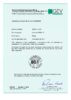
- Certified by the GEV Institute (EC1 Plus) as a product with very low
emissions of volatile organic compounds.
- Before installation, ensure that the rooms are equipped with
appropriate windows or other closures. - The moisture content of the screed must comply with the values
prescribed by local regulations. - If the substrate is not well dry or when the residual moisture is
exceeds the prescribed levels, it is recommended to use suitable waterproofi�ng
primers such as Eco Prim PU 1K, Primer MF, Primer MF EC Plus, etc. - When there is a risk of rising damp, always install a vapour barrier
before applying the screed. - The moisture content of the wooden floor must comply with the values
prescribed by local regulations. - Do not apply the product at temperatures below +10°C or higher than +
35°C. - Apply the product only if the walls and ceilings of the room are well
dry. - Application in very dry conditions requires longer curing times.
Avoid contact with fresh epoxy two-component primers, as this causes the product to
deteriorate. - Non-absorbent surfaces, such as ceramic and marble, should be sanded or
cleaned and then treated with Primer M. - On metal surfaces, apply Primer M beforehand
Preparing the substrate
- It is essential to thoroughly inspect the substrate to assess its
condition and ensure it is suitable for parquet installation.
Cementitious screeds
- They must be cured, dry, flat, and mechanically strong.
- The surface must be free from dust, loose particles, residues of oils,
paints, etc. - The moisture content of the screed should be measured using a carbide
hygrometer. - To address issues due to residual moisture exceeding the allowable
limit for installation, it is necessary to either wait for the screed to dry or
apply suitable waterproofing primers such as Eco Prim PU 1K, Eco Prim PU 1K Turbo,
Primer MF, Triblock P, etc. - Substrates that are not sufficiently solid should be removed or, where
possible, consolidated with primers such as Eco Prim PU 1K, Eco Prim PU 1K Turbo,
Primer MF, Primer MF EC Plus, Prosfas, etc. - When epoxy primers such as Primer MF and Primer MF EC Plus are used,
the substrates should be treated with a dry quartz sprinkle with grain size 1.2 mm
while the primer is still fresh. The same operation must be performed on
polyurethane primers, if the application is carried out after 72 hours. - Cracks and crevices can be repaired with products such as Eporip,
EporipTurbo, Epojet, etc. - Excessively rough or uneven surfaces can be levelled with high-
performance smoothing compounds such as Fiberplan, Ultraplan, Ultraplan Maxi,
Nivorapid, etc., selected based on the required thickness. - Installation can be carried out once drying is complete (see technical
data sheets). - For the creation of fast-drying and shrinkage-controlled screeds, use M
APEI’s special hydraulic binders:- Mapecem which allows installation after 24 hours,
- Topcem after 4 days.
- Alternatively, use Topcem Pronto or Mapecem Pronto, ready-to-use
premixed mortars that allow wooden floors to be installed after 4 days and 24
hours, respectively.
- In the presence of lightweight or insulating layers, and in the case of
screeds installed on fill, provide a suitable vapour barrier to prevent rising damp.
Existing floors made of ceramics, marble, etc
- They must be thoroughly cleaned and degreased before bonding.
- The adhesive can be applied only when the surface is dry.
- Apply the adhesion promoter Primer M before bonding.
Wood floor
- Check that the existing floor slabs are well bonded to the substrate.
- Remove the layer of paint or wax with sandpaper until reaching the wood
surface, and vacuum up the dust. - Proceed subsequently with bonding.
Anhydrite substrates
- Verify that the manufacturer’s instructions for the screed have been
followed, and always check whether the screed requires sanding and subsequent
priming. - MAPEI recommends sanding and priming.
- MAPEI disclaims any responsibility if the manufacturer’s instructions
have not been followed; in case of doubts, please contact Technical Support.
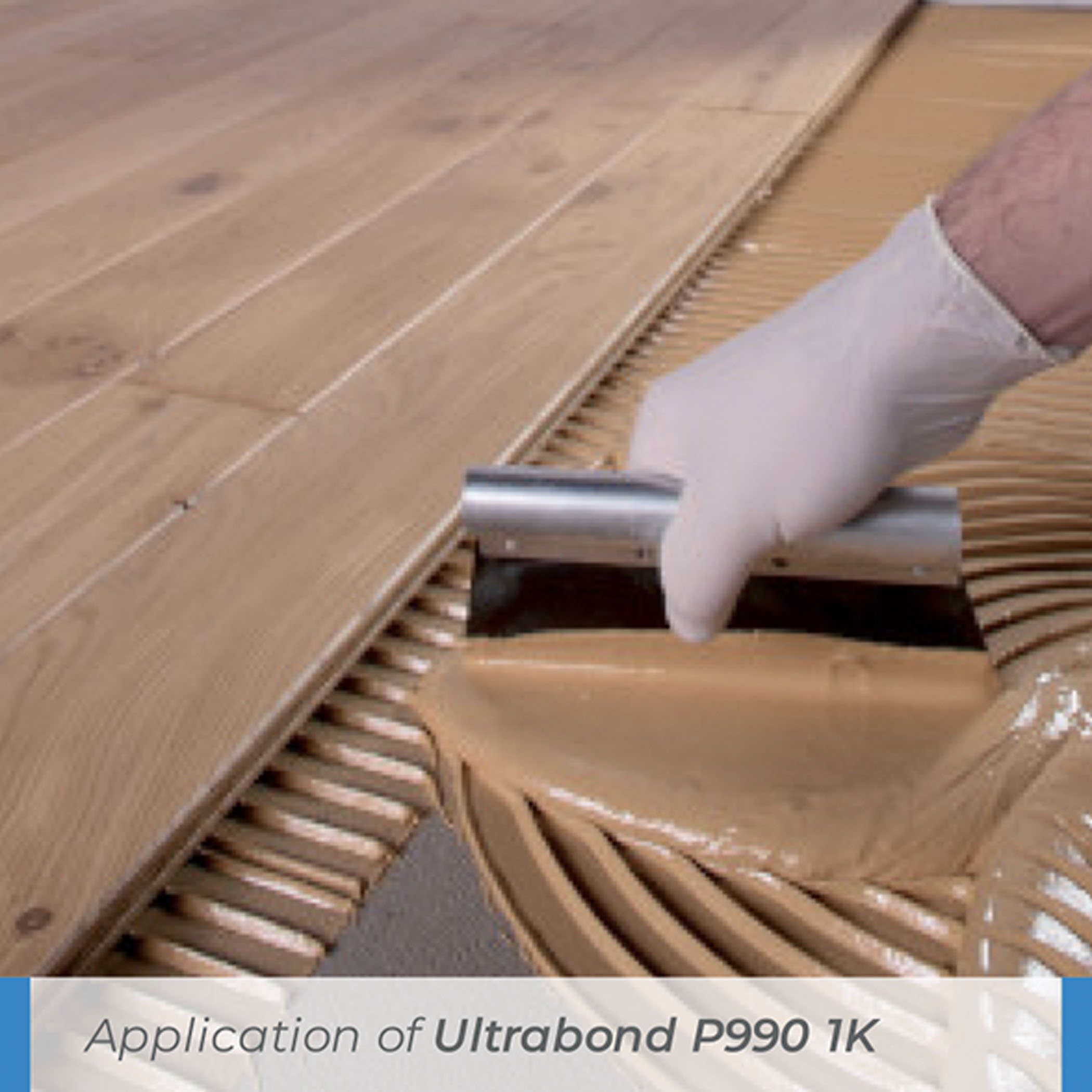
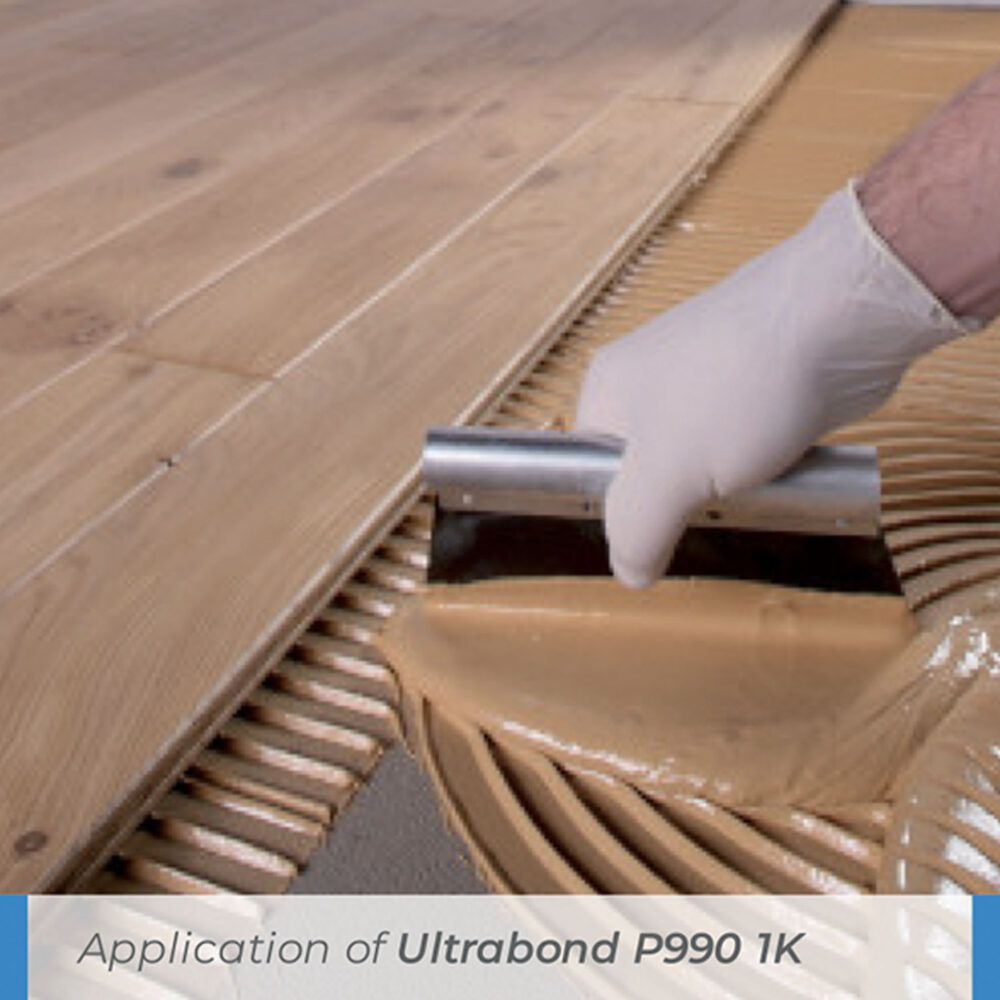
Spreading the adhesive
- Open the aluminium bag contained in the plastic bucket and apply the
adhesive to the substrate using a MAPEI notched trowel for wood, covering the area
with parquet within approximately 110 minutes under normal temperature conditions
(+23°C). - In the case of using partially used packages, open the aluminium bag,
remove any skin that may have formed, and proceed as described above. The skin
layer preserves the remaining product.
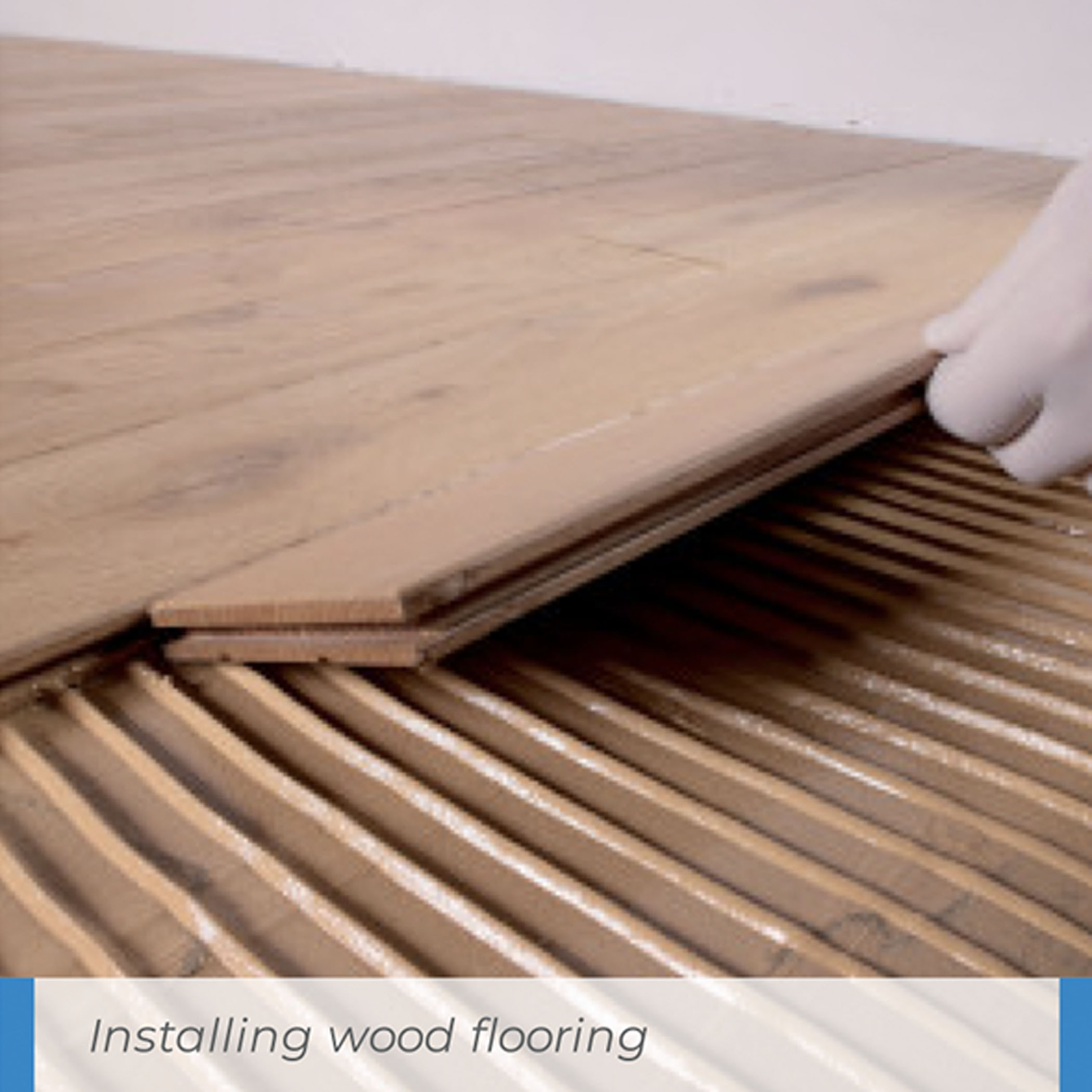
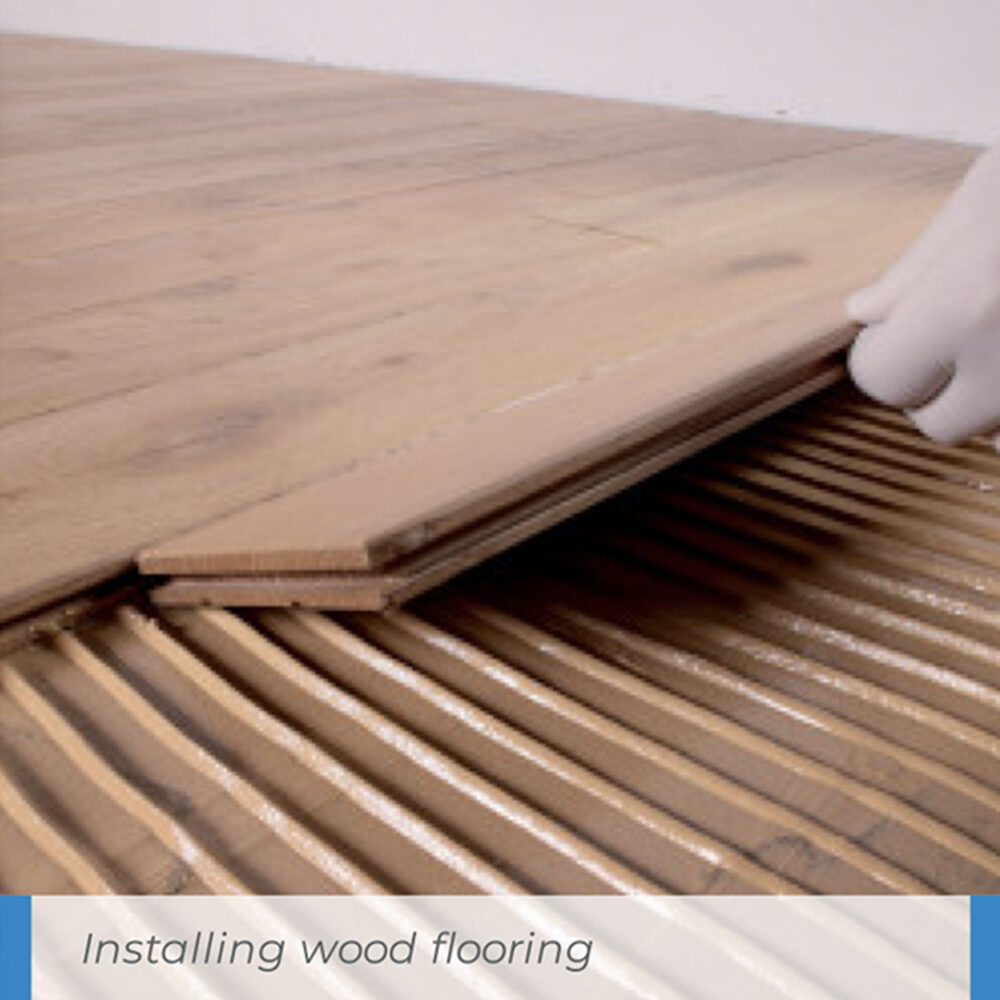
Installing wood flooring
- The parquet to be installed must be stored in a weather-protected, dry
environment free from condensation and should be isolated from the ground. - Before applying it, check that the moisture content of the wood is
correct. - During installation, apply some pressure to ensure good wetting with
the adhesive. - The special rheology of Ultrabond P990 1K allows for easy adjustment.
- Leave an expansion joint of approximately 1 cm along the perimeter of
the flooring, around pillars and other protruding elements. - Do not wet the ends and sides of the planks.
- When installing traditional parquet flooring, do not allow the
adhesive to seep from the ends or sides of the slats; avoid leaving adhesive
residues on the floor, as they may cause discolouration in the joints or staining
on the surface.
Closing partially used packages
- To preserve the remaining product after work is completed, seal the
aluminium bag tightly, expelling as much air as possible to prevent the formation
of a surface skin. Seal the packaging with a zip tie or other equivalent
method. Store everything in the original plastic bucket.
- The floors are set to light foot traffic after approximately 12 hours.
- Sanding can be done after 3 days.
- Any adhesive residues present on the surface of the flooring can be
easily sanded off.
- Ultrabond P990 1K can be removed from tools, while still fresh,
with alcohol or specific products. - After curing, it must be removed using mechanical means or with Pulicol
2000 - Cleaning adhesive residues from prefinished varnished parquet should be
done immediately and, in any case, within 4 hours using Cleaner L.
- Consumption varies with uniformity of substrate, the back of the
flooring and type of trowel used. - approx. 800-1000 g/m².
- 15 and 7 kg in aluminium bags contained in plastic bucket.
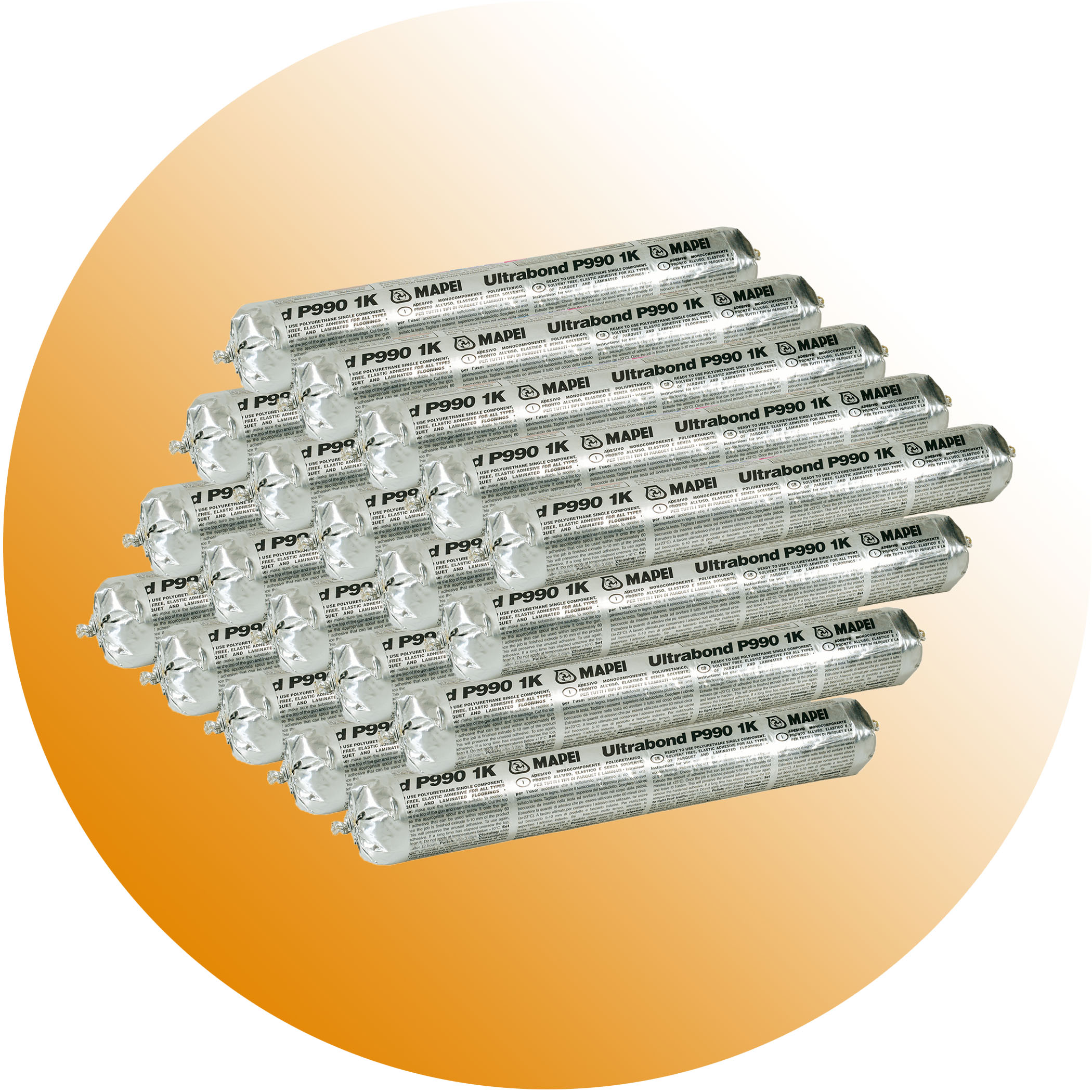
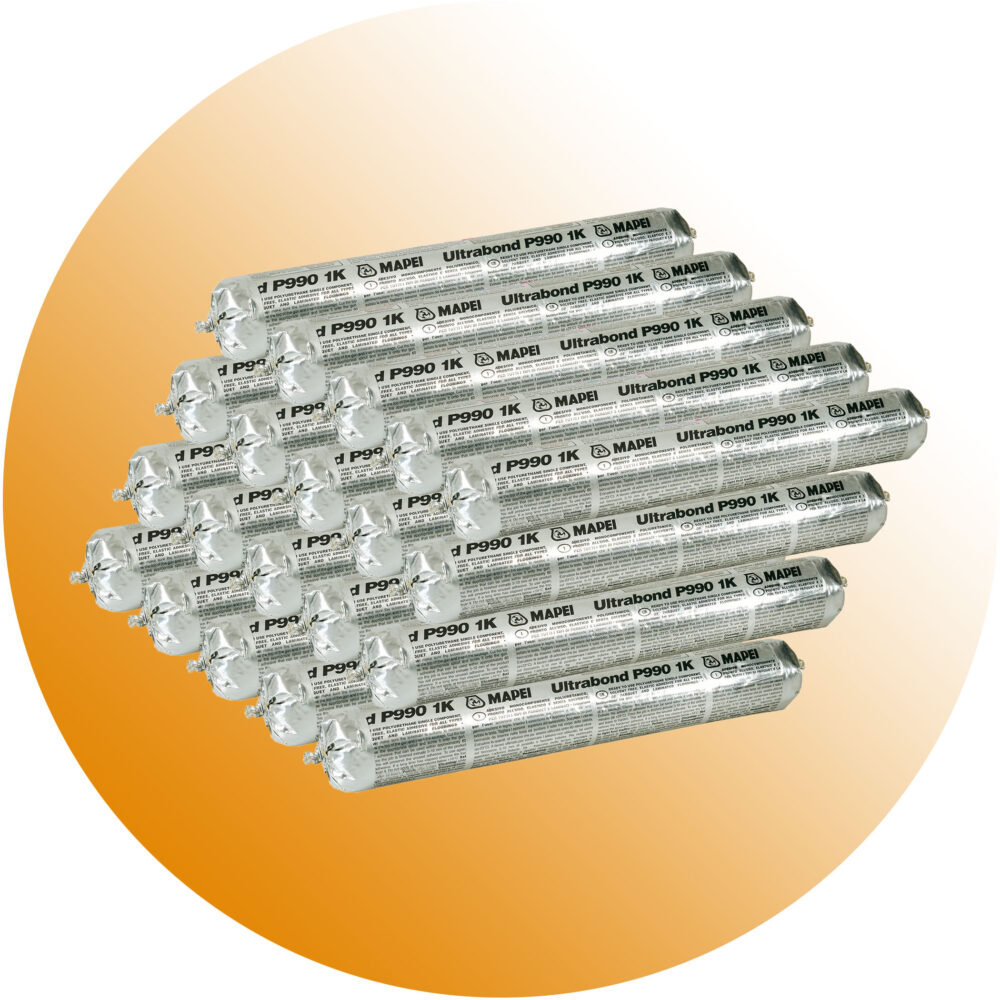
- Cartons containing 20 aluminium sausages of 600 ml.
- Store Ultrabond P990 1K for 12 months in the original tightly closed
packages under normal conditions at temperatures below +25°C. - Long-distance transport may require the use of thermally insulated
containers.
APPLICATION:
- Instruction for the safe use of our products can be found on the latest
version of the SDS available from our website www.mapei.com. - PRODUCT FOR PROFESSIONAL USE
- Consistency: creamy paste.
- Colour: beige, brown.
- Density: 1.4g/cm3
- Dry Solids Content: 100%
- Free Monomer: <1%
- EMICODE: EC1 Plus – Very Low Emission
- Recommended application temperature range: +10ºC to +35ºC
- Open time (skin formation): 110 minutes.
- Adjustment time: 3 hours
- Set to light foot traffic: after 12 hours.
- Sanding: after 3 days
- Service Temperature: -10ºC to +70ºC