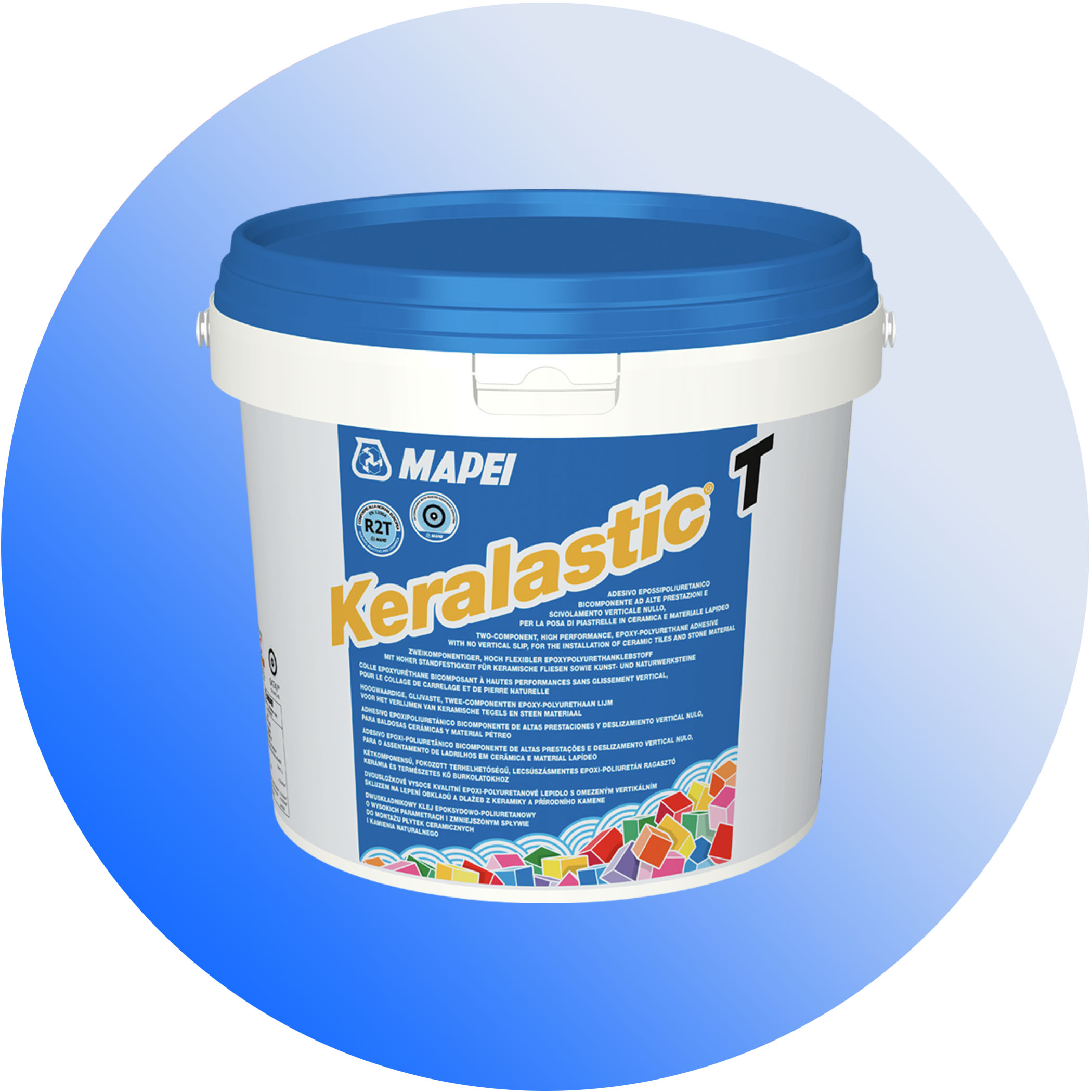
Description
Mapei Keralastic T is a two-component polyurethane adhesive for fixing ceramic tiles, stone and mosaics on substrates including wood, metal, PVC and asphalt as well as screeds, renders and concrete. Made by Mapei, it is mixed from a resin and a hardener in one pre-measured pack.
Keralastic T is the highly thixotropic version, so it can be applied vertically without slump. The data sheet covers Keralastic and Keralastic T; details here are for Keralastic T.
Technical Specifications
| Classification | R2T to EN 12004 and ISO 13007-1 |
|---|---|
| Mix ratio by weight | Component A : component B = 94 : 6 |
| Pot life (23 degrees C, 50% RH) | 30 to 40 minutes |
| Open time (EN 1346, 23 degrees C, 50% RH) | 50 minutes |
| Ready for use | 7 days |
| Initial shear adhesion strength (EN 12004) | 2.6 N/mm2 |
Consumption
| Tile type | Trowel | Consumption |
|---|---|---|
| Mosaics and small size tiles | No. 4 | 2.5 kg/m2 |
| Normal size tiles | No. 5 | 3.5 kg/m2 |
| Large size tiles, marble, stones | Back buttering | 5 kg/m2 |
Where to Use
Indoor and outdoor bonding of wall and floor ceramic tiles, stone and mosaics, including:
- Showers and prefabricated bathroom sheets
- Wooden work surfaces and kitchens, using a continuous layer of at least 1 mm that tile ribs and lugs do not pierce, to achieve a waterproof substrate
- Balconies, external terraces, domes and roofs subject to foot traffic
How to Apply
- Prepare the substrate. It must be cured, mechanically strong, free of loose particles, grease, oil, paint and wax, and sufficiently dry. Remove rust on iron surfaces by sandblasting, and reinforce gypsum, gypsum board and anhydrite substrates with a coat of Primer EP or Primer MF. Cement substrates must not be subject to shrinkage after tiling. In spring and summer, cementitious screeds must be cured at least 28 days and renders one week per cm of thickness, unless made with Mapei special screed binders; otherwise adhesion is greatly compromised.
- Mix. Pour the hardener (component B) into component A and mix well to a uniform paste, using a low speed electric stirrer. Use the whole pack. Use the mix within 30 to 40 minutes.
- Spread. Use a notched trowel giving at least 65 to 70% coverage of the tile back.
- Lay the tiles. Tiles must be absolutely dry. Press firmly for good contact. On particularly deformable substrates, install all coverings larger than 5 x 5 cm with wide joints. Open time is about 50 minutes; adjust within 90 minutes.
- Grout and clean. Joints can be grouted after 12 hours with Mapei cementitious or epoxy grout.
Important Notes
- Use between 10 degrees C and 30 degrees C. Components are pre-measured; do not use partial quantities.
- Do not use on very damp surfaces or where there is a risk of rising damp. The data sheet gives no instructions for continuous immersion in water, so that use is not covered here.
- Do not use to bond transparent glass materials. The data sheet advises against particularly porous or light coloured natural stones, naming Ultrabond Eco PU 2K instead.
- Store component B in a warm place, at least 10 degrees C, to avoid crystallisation. Product for professional use only.
Safety and handling
As stated in the data sheet: component A is irritant for eyes and skin, and both components A and B may cause sensitisation if they come into contact with the skin of those predisposed. Component B is corrosive, may cause serious burns and is harmful if swallowed. The product contains low molecular weight epoxy resins that may cause sensitisation if cross-contamination occurs with other epoxy compounds. During use wear protective gloves and goggles and take the usual precautions for handling chemicals. If the product comes in contact with the eyes or skin, wash immediately with plenty of water and seek medical attention. Component A of Keralastic T is hazardous for aquatic life; do not dispose of it in the environment.