Description
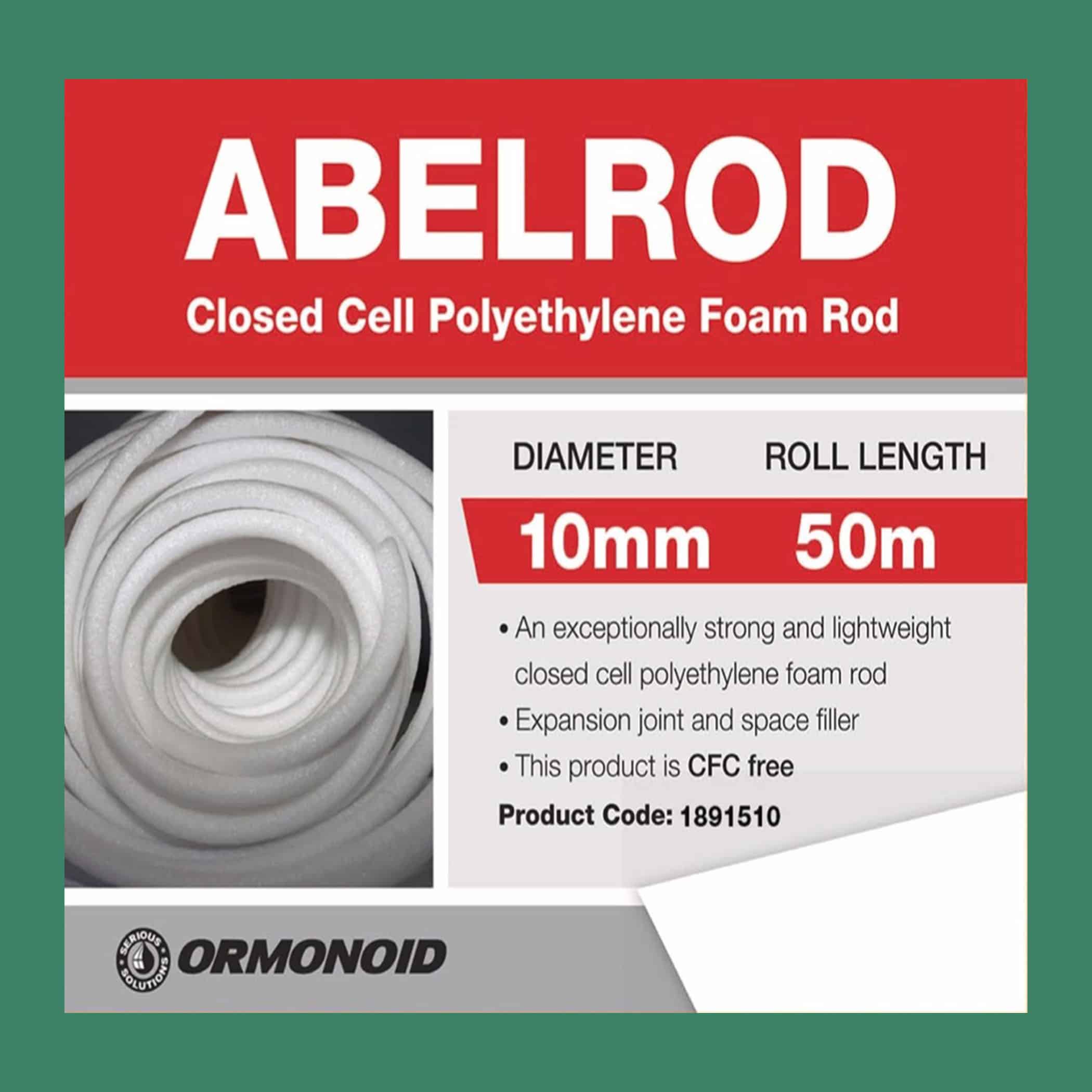
Ormonoid AbelRod is a closed-cell polyethylene foam rod built as a joint filler and expansion-joint backer, exceptionally strong and lightweight for its size. Its excellent recovery properties are what make it genuinely durable in a joint that moves — after years of repeated compression and expansion from thermal and structural movement, it still holds a tight seal against dirt and water entry rather than permanently compressing and losing contact with the joint walls.
As a backer rod ahead of sealant application, it does a job that’s easy to underrate: controlling sealant depth and preventing three-sided adhesion within the joint, both of which let a sealant bead flex properly as the joint moves instead of tearing from being bonded on too many sides. Meeting AS2170 for food contact use also broadens where it can be specified beyond general construction joints.
Technical Specifications
| Appearance | White flexible strips |
|---|---|
| Solubility in water | Insoluble |
| Density | 30 kg/m³ |
| Roll length | 50m |
| Roll diameters | 6, 10, 13 or 20mm |
| Shelf life | Unlimited, stored dry |
| Compliance | AS2170 Plastic Materials for Food Contact Use |
Where to Use
- Vertical and horizontal joints in concrete and masonry, between precast panels
- Interior walls, skylights, shop fronts and curtain wall construction
- Swimming pools, draft-proofing and dust sealing
- Sealing electrical control boxes, and truck/trailer construction
How to Apply
- Select the correct diameter — choose from 6, 10, 13 or 20mm to suit the joint width.
- Cut to length — trim from the 50m roll to the required run.
- Compress into the joint — insert the rod to control sealant depth and prevent three-sided adhesion.
- Apply the sealant — apply the chosen sealant over the backer rod per the sealant manufacturer’s instructions.
Important Notes
- Store in dry conditions to preserve its unlimited shelf life.
- Highly resistant to weathering and most common chemicals once installed.
- Select rod diameter slightly larger than the joint width for correct compression fit.
< Selecting the right diameter relative to the joint width is what determines whether that compression fit is achieved correctly, since a rod that's too small won't compress enough to stay seated, and one that's too large can be difficult to install cleanly. Buying by the roll rather than pre-cut lengths also means offcuts from one job can be carried over to the next, reducing wastage on smaller repair or retrofit jobs where only a short run of backer rod is actually needed. A quick check of joint width with a simple gauge or ruler before ordering avoids the common mistake of guessing rod diameter and ending up with a poor compression fit on site.
The 50m roll length matters for larger commercial jobs specifically, where a shorter pre-cut length would mean managing multiple joins along a single long expansion joint run. Being able to feed continuous rod from one roll into a long joint, cutting only at the very end, gives a cleaner, more consistent result than piecing together several shorter lengths end to end. Storing offcuts back on the roll rather than as loose lengths also makes them easier to find and reuse on the next applicable job.