Description
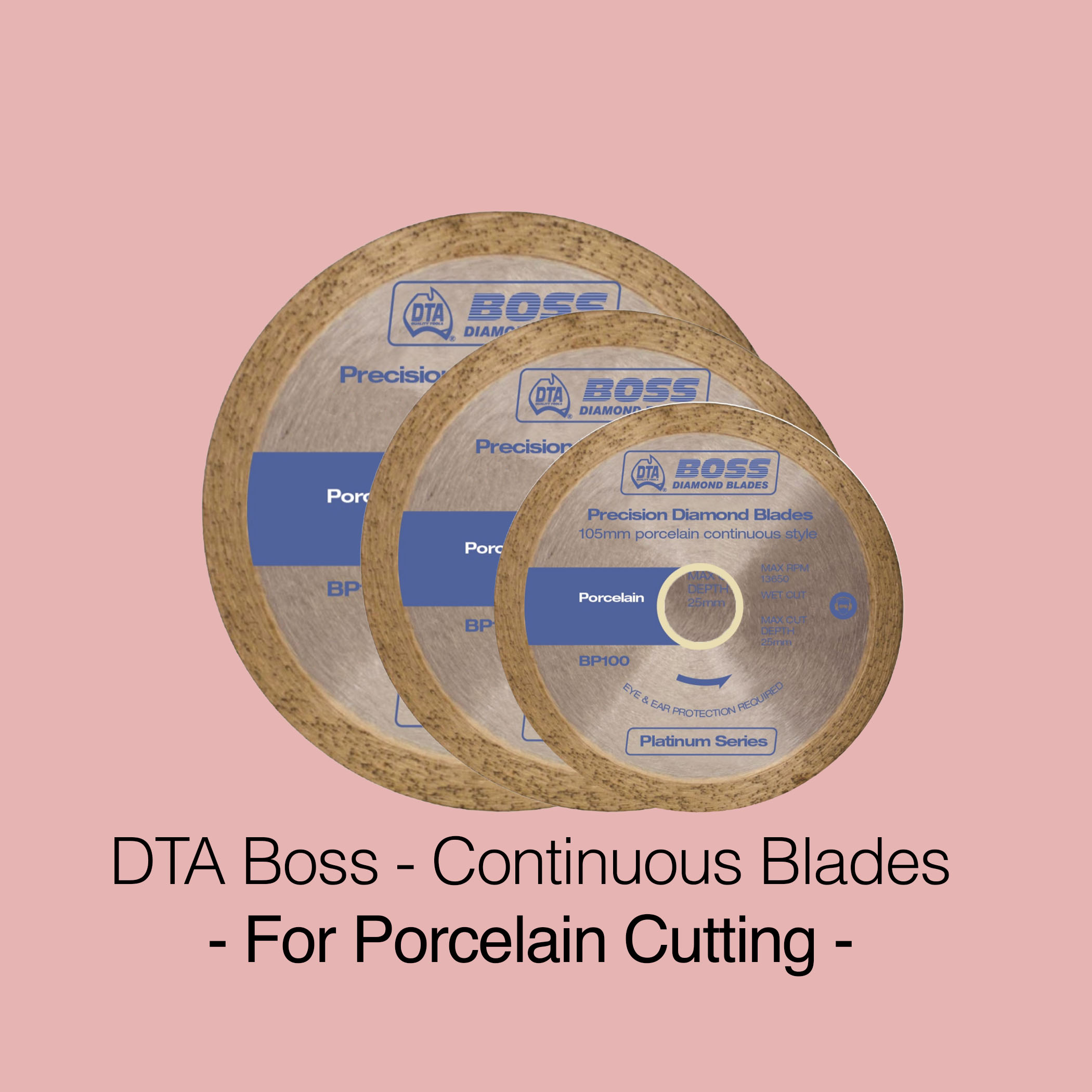
These DTA Boss blades have a continuous rim carrying a high concentration of fine diamond for smooth, chip free cutting of porcelain and vitrified tiles. This listing covers the 200, 250 and 300 mm diameters.
DTA’s application guide places them in its porcelain continuous group, the RAB range, which it describes as wet cutting blades that must be used with water.
Technical Specifications
The speed and depth figures below are from DTA’s general RPM chart, which is listed by blade diameter in its Diamond Blade Application Guide. They are not separate specifications for this product.
| Brand | BOSS by DTA |
|---|---|
| Rim type | Continuous |
| Use | Wet use only, requires water as a coolant |
| Product codes | RAB200P (200 mm), RAB300P (300 mm) |
| Maximum RPM, 200 mm (DTA RPM chart) | 7,500 |
| Maximum RPM, 250 mm (DTA RPM chart) | 6,100 |
| Maximum RPM, 300 mm (DTA RPM chart) | 5,100 |
| Maximum cutting depth, 200 mm (DTA RPM chart) | 70 mm |
| Maximum cutting depth, 250 mm (DTA RPM chart) | 87 mm |
| Maximum cutting depth, 300 mm (DTA RPM chart) | 100 mm |
How the Blade Is Made
DTA states that its continuous, segmented and turbo rim blades are made by cold press sintering. The diamond and bond mixture is pressed onto the steel core of the blade, then heated to 900 degrees in a furnace, and DTA says no welding of any kind is used in the process.
Where This Blade Sits in the DTA Range
DTA groups its blades by rim type. Wet continuous blades (RA range) cut cleanly and precisely and must be used with water. Porcelain continuous blades (RAB range, including these) are wet cutting blades with a high concentration of fine diamond for smooth chip-free cutting, and must also be used with water. Dry continuous blades (RAD range) use higher quality diamonds in a faster heat-conductive bond powder and can be used wet or dry.
Where to Use
DTA recommends these blades for porcelain and vitrified tiles. The product pages for the 200 and 300 mm sizes list ceramic, porcelain, slate, marble, granite, terracotta, fibreglass and fibro cement as suitable materials. Use them only on a machine that supplies water to the blade and runs at or below the maximum RPM for the blade’s diameter.
How to Use
- Choose the diameter that suits the cutting depth needed, using the maximum cutting depth for each size.
- Check that the blade’s bore size suits the arbor of your machine.
- Supply water to the blade as a coolant for the whole cut, because the blade is for wet use only.
- Keep the machine at or below the maximum RPM for the blade’s diameter.
Important Notes
- Wet use only. Do not use the blade without water.
- Never exceed the maximum RPM listed for the blade diameter.
- DTA lists dry continuous blades and segmented, turbo and mesh blades as separate ranges for other applications.