Description
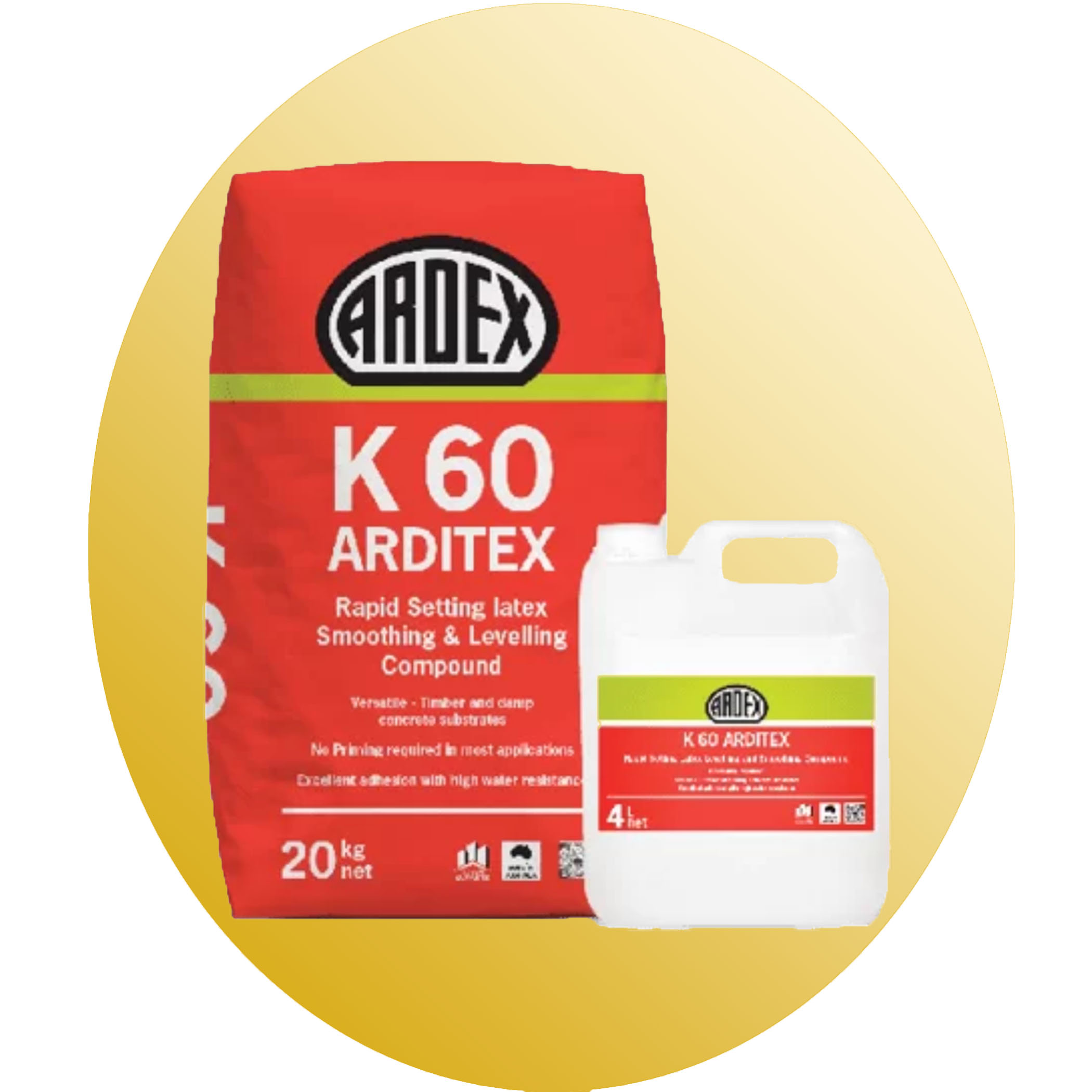
ARDEX K60 ARDITEX is a self-smoothing and levelling compound made up of a two-part latex liquid and a cementitious powder. The latex gauging gives it outstanding adhesion and enough flexibility to be installed over timber floors, and enough water resistance to be used under flexible waterproof membranes. Manufactured by ARDEX Australia.
What it removes from the job is the priming step. Most levelling compounds need a porous, primed, dry substrate; ARDEX K60 ARDITEX bonds without priming in most applications, including over timber, existing tiles and damp concrete – which is what makes it the usual choice for a refurbishment where the existing floor is neither ideal nor coming up. Walkable from 2 hours and ready for ceramic tiles in 4 to 5 hours. Also written ARDEX K 60 Arditex.
Technical Specifications
| Product type | Two-part latex and cement smoothing and levelling compound |
|---|---|
| Mixing ratio | 20 kg powder to 4.8 litres of ARDEX K60 ARDITEX latex liquid |
| Mixing time | 2-3 minutes with an ARDEX mixing paddle and heavy-duty drill (650 rpm) |
| Working time | Do not rework after 10 minutes |
| Application thickness | Featheredge to 12 mm in one application; 12-30 mm with ARDEX 2-5 mm aggregate |
| Walkable | From 2 hours at 23 degrees C and 50% RH |
| Ceramic, quarry, porcelain tiles | 4-5 hours |
| Rubber, PVC vinyl, linoleum, wool textile | 24 hours when installed under 12 mm thick |
| Compressive strength | Approx. 5 MPa at 1 day; 6 MPa at 3 days; 10 MPa at 7 days; 13 MPa at 28 days |
| Flexural strength | Approx. 2.0 MPa at 1 day; 3.5 MPa at 3 days; 4.5 MPa at 7 days; 6.0 MPa at 28 days |
| Bulk density of powder | Approximately 1.2 kg/L |
| Mixed mortar density | Approximately 1.8 kg/L |
| Priming | Not required in most applications |
| Coverage | Approximately 1.8 kg per square metre per mm |
| Packaging | 20 kg bag plus 4.8 L latex liquid |
| Shelf life | 12 months unopened, stored dry at 23 degrees C and 50% RH |
Coverage Rates
Consumption is approximately 1.8 kg of mixed mortar per square metre per millimetre of thickness. A 20 kg bag with its 4.8 litres of latex liquid covers approximately 13 m² at 1 mm.
| Thickness | Coverage per kit (20 kg powder + 4.8 L liquid) |
|---|---|
| 1 mm | Approx. 13 m² |
| 2 mm | Approx. 6.5 m² |
| 3 mm | Approx. 4.3 m² |
| 5 mm | Approx. 2.6 m² |
| 10 mm | Approx. 1.3 m² |
| 12 mm | Approx. 1.1 m² |
Figures assume an even substrate. Above 12 mm the compound is bulked with ARDEX 2-5 mm aggregate, which reduces powder consumption.
Where to Use
- New and existing concrete
- Concrete subfloors with electric underfloor heating
- Timber floors
- Terrazzo, quarry and ceramic tiles
- ARDEX A 38, ARDEX A 48 and ARDEX K 900 BF
- Under flexible waterproof membranes
- Existing epoxy coatings, lightweight autoclaved concrete and primer-treated metal – all substrates with special requirements, so confirm with ARDEX Technical Services first
How to Apply
- Prepare the subfloor – it must be solid, clean and free of dust, plaster droppings, grease, paint, polish, other contaminants and any loosely adhered or water-soluble material. Re-nail and firmly fix loose boards on timber floors, and sand off the wax coatings and sealers found on some particleboard and chipboard.
- Check moisture – where concrete moisture exceeds 80% relative humidity (ASTM F2170) or 15 g/m²/24 hrs (ASTM F1869) tested to AS 1884, use a moisture stop: one coat of ARDEX WPM 300 at 3 m² per litre with primer sand broadcast into the wet film, or one coat of ARDEX WPM 368 at 3 m² per litre, over which the compound goes directly. Where rising damp is present or moisture exceeds 90% RH, refer to ARDEX Technical Bulletin 192.
- Prime only if needed – no priming is required in most applications. Absorbent concrete may be primed with ARDEX P 51 diluted 1:2 with water to minimise pinholes; the primer must be dry before proceeding.
- Mix – pour 4.8 litres of ARDEX K60 ARDITEX latex liquid into a clean container and add the 20 kg of powder while mixing, using an ARDEX mixing paddle on a heavy-duty electric drill at 650 rpm. Mix for 2 to 3 minutes to a lump-free mortar. Always mix the powder into the liquid. Concrete mixers and hand mixing are not suitable.
- Place – pour onto the prepared subfloor and spread with an ARDEX gauging rake set to the required thickness, working in studded boots to avoid marking the surface. Smooth with the ARDEX stand-up spreader and a hand trowel where needed. Do not rework after 10 minutes.
- Build up if required – further layers can be applied once the previous layer has hardened sufficiently, priming between layers. For 12 to 30 mm, mix the powder into the latex liquid first, then add up to an equal weight of ARDEX 2-5 mm aggregate while mixing. High-aggregate mixes may need a finishing layer, in which case prime the base layer first to prevent pinholes and improve flow.
Important Notes
- Drying times are based on 23 degrees C and 50% relative humidity. Higher temperatures shorten setting, hardening and drying; lower temperatures extend them.
- Always comply with the floor covering manufacturer’s moisture instructions.
- Rubber, PVC vinyl, linoleum and wool textile coverings need 24 hours and require the compound to be installed at less than 12 mm thickness.
- Installation over adhesive residue is possible where the residue is sound, well bonded and moisture insoluble – as a guide no more than 33% per square metre, no single patch larger than 50 x 50 mm, and less than 1 mm thick. Remove all poorly bonded residue and vacuum thoroughly.
- Best practice is still to grind floors clean of adhesive and other residue. Installing over excessive, water-soluble or poorly adhered residue increases the risk of failure and is not covered by ARDEX.
- Always confirm an installation on site with a representative trial area.
- Subfloor ventilation under timber floors must be adequate to prevent damp building up.
- Store in the original unopened packaging in a dry place; shelf life is 12 months at 23 degrees C and 50% relative humidity.