Description
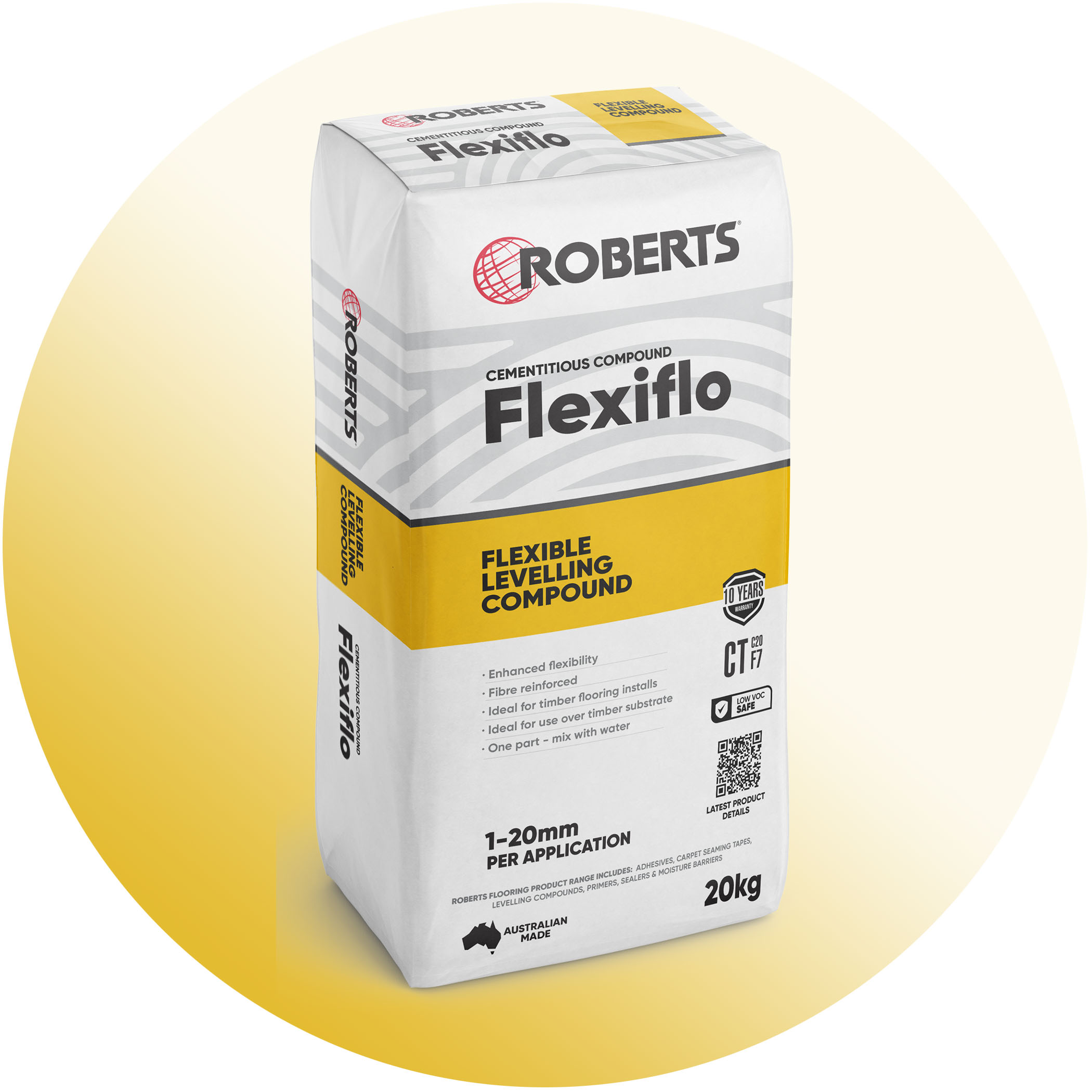
Roberts FlexiFlo Rapid Drying Timber Floor Leveller
– 1mm to 20mm Build Thickness
– Available in 20kg Bags
Roberts FlexiFlo is rapid drying self-levelling compound with excellent flow
properties formulated for levelling differences from 1 to 20 mm in thickness on new
or existing internal Concrete and Timber substrates. It develops smooth and even
surfaces with high levels of mechanical resistance, ensuring the subsequent
installation of floor coverings.
FEATURES & BENEFITS:
- Enhanced Flexibility
- Thickness 1mm to 20mm
- Fibre Reinforced
- Ideal for Installing Timber Flooring
- Pump application
- Ideal for use over Timber Substrates
- Simple mix with water
SUBSTRATES:
Substrates suitable for application of Roberts FlexiFlo Include:
- Concrete
- Timber
- Particle Board
When installing Timber Flooring over a concrete substrate, the levelling coat of
Roberts FlexiFlo must be no less than 3mm.
RECOMMENDED USE:
- It is ready to accept most floor coverings after approximately 12 hours
and allows for quick and reliable installation. - Installations of Timber floorcoverings can take place 24 hours after
application. - Once dry, it is suitable for the application of vinyl, timber,
flooring, carpets, linoleum, and tile floor finishes. - Roberts FlexiFlo is suitable where good resistance to loads is required, also for wheelchair traffic and underfloor heating systems.
- INTERNAL USE ONLY
CLASSIFICATION ACCORDING TO EN 13813:
- The material properties of Roberts FlexiFlo are classified as
CT-C20-F7
SURFACE PREPARATION:
- The minimum subfloor temperature before commencing installation should
be 10°C. - Concrete substrates must be at least 14 days old.
- Surfaces must be prepared thoroughly before commencing application.
- All substrates must be structurally sound, smooth, stable, dry, and
clean. - Rough surfaces and voids should be evened or filled first, and all
brick/block surfaces should be pointed flush. - All general surface defects are to be repaired.
- Building surfaces must be constructed to the manufacturer’s
recommendations and relevant building standards in force at the time of membrane
application. - All surfaces must be free of sharp protruding objects, loose
material, de-bonded coatings, curing membranes/agents, release agents, wax
residues, foreign particles, laitance, algae and moss grime, oils, animal fats, or
grease remains. - Structurally unsound layers and surface contaminants must be
mechanically removed by abrasive blasting, blast tracking, grinding or equivalent
methods. - For resilient installations, relative humidity and pH readings must be
carried out on the concrete substrate by Australian Standard 1884-2021. - If required, use RLA MOISTURE SEAL.
- When installing Timber Flooring over a concrete substrate, the
levelling coat of Roberts FlexiFlo must be no less than 3mm. - If temperatures are less than 5°C or higher than 35ºC, please contact
the RLA Technical department for further details.
PRIMING:
- Prime substrates with ROBERTS R48 UNIVERSAL PRIMER
Porous Substrates:
- Mix one (1) part Universal Primer with two (2) parts of clean water.
- Apply an even film using a roller or brush, ensuring the entire area is
covered and allowed to cure. - Highly absorbent or porous surfaces may require a second coat of
ROBERTS R48 UNIVERSAL PRIMER to avoid pinholes. - For the preparation of timber floors and Particle Board Flooring apply
Roberts Universal Primer in NEAT format.
Non-Porous Substrates:
- Substrates such as ceramic tiles have no coatings or sealing compounds
on the surface before applying primer. - Coatings, curing, and sealing compounds must be mechanically removed
from concrete substrates. - Apply an even layer of ROBERTS R48 UNIVERSAL PRIMER neat (undiluted to
non-porous substrates). - Allow the primer to dry (approx. 2 hours @ 23°C).
- Once Primer is a tack-free transparent film, products can be applied
over the primer
Examples of Non-Porous Substrates:
- Burnished Concrete, Ceramic Tiles, Liquid Waterproofing membranes.
- NOTE 1: For extremely non-porous substrates, it is recommended
that a light grind or sand be conducted to enhance adhesion. - Determining whether a substrate is POROUS or NON-POROUS, pour water
from a bottle or a dropper forming a puddle onto the substrate surface, the size of
a 10-cent coin. - If the water absorbs into the substrate in less than ONE (1) minute,
the substrate is POROUS. - If the puddle remains, the substrate is NON-POROUS.
- NOTE 2: ATSM F3191-16 Standard Practice for Field Determination
of Substrate Water Absorption (Porosity) for Substrates
MIXING RATIO:
- Mix one 20kg bag with 4.6-4.8 litres of clean water.
- Mixed with a forced action, high shear stirrer, powered by a heavy-
duty electric mixing drill at approx. 600 rpm. - Add pre-measured water to a clean mixing bucket.
- Gradually add Roberts FlexiFlo into the water while mixing the bucket’s
contents. - When the entire contents of the bag have been added to the water, mix
for a further three (3) minutes to produce a smooth homogenous consistency. - DO NOT MIX BY HAND & DO NOT ADD EXCESS WATER.
TIMBER FLOORS:
- Timber Floors Timber flooring must be solid, sound, clean, free from
wax and oil, free from gaps and securely fixed by the Timber Flooring Manufactures
Instructions and relevant Australian Standards. - Before levelling Timber Flooring, please ensure the flooring is solid
and firmly fix any loose boards that need to be re-nailed or repaired before
levelling. - Please note: Timber flooring may be coated with a resin or waterproof
protective layer. - Particle board flooring contains wax coatings or sealers and can affect
adhesion to applied finishes. - These resins, sealers, and wax coatings must be removed by mechanical
means before applying a primer. - Please ensure the substrate is vacuumed before using a primer.
- Check the humidity content with a hygrometer or an electric moisture
meter to ensure compliance with the Australian Standards before commencing work. - Subfloor crossflow ventilation must be adequate and by the relevant
Australian Standards to prevent the build-up of dampness.
APPLICATION:
- Apply in one coat from 1mm to 20mm.
- Apply the mixed compound to the primed substrate using a gauge rake,
stand-up spreader at the required height adjustment, or trowel on a slight incline
to obtain the necessary thickness. - Larger installations can also be pumped using an appropriate mixing
pump. - The mixed quantity must be used within 15 minutes at a temperature of
23°C. - Due to its self-levelling properties, Roberts FlexiFlo will quickly
develop a smooth finish and even surface.
SETTING TIMES:
- When applied will harden after 2-3 hours at 23°C and can be walked on
after this time. - The levelling coat will be ready to receive floor coverings fixed with
adhesives after 12 hours at 23°C (time may vary depending on temperature and
humidity).
COVERAGE:
- One 20 kg Bag of Roberts FlexiFlo mixed with 4.6-4.8 litres of
water will cover approximately 4m² @ 3mm thickness
CLEAN UP:
- Clean tools immediately after use with water.
SHELF LIFE/STORAGE:
- 12 months when stored in original unopened packaging.
- Stored in a dry area off the ground.
PACKAGING:
- 20kg bags
NOTES AND PRECAUTIONS:
- Drying times can be extended when applied in cold ambient
temperatures. - Do not allow it to come in contact with water during or after the
curing process. - Do not apply on substrates with rising dampness.
- Internal use only.
- Do not apply over expansion joints, as reflective cracking may occur.
COMPATIBILITY:
- Roberts FlexiFlo is compatible with the ROBERTS range of moisture
seals, primers, carpet, resilient, and timber adhesives.
APPLICATION AND PERFORMANCE DATA:
- Refer to the attached Technical Data Sheet
HEALTH AND SAFETY:
- Do not breathe dust. Wear suitable respiratory protection.
- Use in well-ventilated areas.
- Avoid contact with skin and eyes.
- Wear eye protection and suitable gloves and clothing.
- Do not eat, drink, or smoke while using this product.
- Take off contaminated clothing and wash it before reuse.
- If on the skin, wash with plenty of soap and water.
- If in the eyes: rinse cautiously with water for several minutes.
- Remove contact lenses; if present, continue rinsing.
- If inhaled, remove them to fresh air and keep them at rest in a
position comfortable for breathing. - If any skin or eye irritation persists or you feel unwell, get medical
attention. - The Safety Data Sheet is available upon request.
FIRST AID:
- Skin: Wash off with warm water and soap.
- If swallowed, DO NOT induce vomiting. Give a glass of water.
- For advice or if you feel unwell, contact a Poisons Information Centre:
Australia ph. 131126,nNew Zealand ph. 0800 764 766 or a doctor at once. - If swallowed, do NOT induce vomiting.
- IF SWALLOWED, immediately call the Poisons Information Centre or a
doctor. - IF ON SKIN Remove immediately all contaminated clothing and wash skin
with soap and water. - If skin irritation occurs, get medical advice/attention.
- IF IN EYES Rinse carefully with water for several minutes.
- If eye irritation persists, get medical advice/attention.
If poisoning occurs, contact a doctor or Poisons Information Centre.